(3)
KLYAGIN, G. & ZUBENKO, Y.
Donetsk State Technical University, 58, Artema, 340000 Donetsk, Ukraine, dfst@pop.dgtu.djnetsk.ua; www.dgtu.djnetsk.ua
Abstract: The system analysis is considering as the science about systems. Accordingly, it has determined the object and the methods of the investigation, the structure and the connection with the another’s sciences. It has elaborated the general theory of the systems in the environment of the calculation of the statements and it has determined the ways of the utilization of the different mathematical theories.
For the Universities it has elaborated the educational courses «The system analysis», «The management on the basis of the system analysis» and also an application of the system analysis at the different educational courses of the management (administration, control).
At the ferrous metallurgy it has executed the system analysis of the management (administration, control) systems of the technologically processes and the undertakings. It has determined the ways of the perfectionement of these systems.
Keywords: education, system analysis, management, metallurgy
The manufacturing system of the metallurgical works (firm) on the base of systems analysis is investigated.
(a1) The firm, as is known, is a subject of market economies intended for coordination of solutions of the owners of manufacturing resources. The metallurgical works introduce both state, and private property. The purpose of the owner of a private firm is to maximize profit. Same can be considered (with allowance for such as the property) and purpose of the firm. The state-owned firm is a public property, in which one the state fulfills a role of the manager. If the segment of the market, on which one works this corporation, envelops the population or other state-owned firms, for such corporation the purpose can not be a maximization of the profit. The purpose of a state-owned firm can be formulated as " sufficing of public needs ".
(a2) The profit is a difference between the general proceeds or general inflows, which one are received by the firm from sale of production, and general economical costs, which one are born by the firm to produce this production. The general economical costs estimate all resources, utilized during manufacture, according to a principle of alternate costs.
(a3) The process of manufacture is described by production function setting association between used resources (the factors of manufacture) and output. The production function of Коbbа-Douglas or exponential function of expenditures of a transactions (L) and capital (К) is widely used:
|
Q = AKaLb |
(1) |
where Q is the volume of production,
A, a, b are factors.
One more production Leontev`s function:
|
Q = min (aK, bL) |
(2) |
where a, b - capacity factors of resources is applied in sample pieces of productions with a fixed relation between expenditures of used resources. Other production functions are known also.
(a4) The short time phase of operation of the firm is a temporal interval, during which one the firm can not change a volume at least of one of aspects, available for its manufacturing resources. The long time phase of operation of the firm is a temporal interval, during which one the firm can change volumes (amount) of all occupied resources, including the productive capacities.
(b1) the universal set (1) as a substance with infinite number of properties (s), infinite in time (Т) and in space (R) is entered. In a universal set the actual object (N) with properties (SN), exhibited in time (tÎT) and in a part of space (rÌ R) is selected. The environment (V) is determined by a condition:
|
(3) |
Between V and N there is a boundary (G1), defined ration:
 |
(4) |
(b2) The system is " a population of properties of actual object realizing a uniform function ". Let part of properties of object N is the formed of the system (si) and this properties are integrated by a uniform function (F). Then in N there is a second part of properties (sB), which one will form so-called base (B) of a system at t and r.
Thus the relation is abided:
 |
(5) |
The system (S), following to definition, is formally entered as
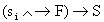 |
(6) |
With allowance for of availability of a system and some approximation it is supposed, that N ~ S Ú B also it is possible to accept, that
 |
(7) |
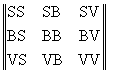
Then the external rationes of a system are injected from the matrix (3*3):
|
|
(8) |
as its part:
|
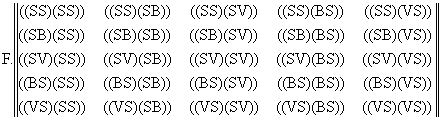
<SS, SB, SV, BS, VS> |
(9) |
The function of a system is integrated developments, i.e. developments in the ratios (9). The wholeness is encompass byed volume, that any of the rationes (9) influences all ratios (9), i.e. the function F is determined by a lower die of the ratios of the ratios (9):
|
|
(10) |
Thus, entrance ( ) and output (
 ) the actions on a system are a part of the ratios (9), and internal transformations in a system are part of the ratios of the ratios (10), i.e.
|
|
(11) |
(c1) According to definition, the system is identified on N, Si, F. The availability of a system can be determined also on entrance and output vectors (, ).
(c2) In the firm it is possible to secure(discharge) some pairs entrance and output streams (vectors): financially - material ( ,
,  ), fitting different needs; cost (income
  , consumption
  ), establishing relative value of financially - material streams; financial (
 ,
,  ), showed the position of the firm in the market; information (
 ,
,  ), permitting mutually to map the firm and its environment.
(c3) Financially - material streams (,  ), testify to availability in the firm of a technological system (S1) with function F1 on transformation:
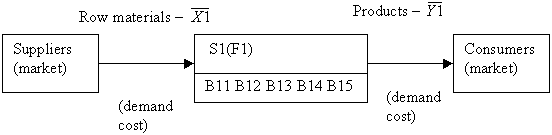
Fig. 1

Fig. 2
The base of a technological system (В1) includes: means of production (В11), flow diagrams (В12), factory personnel (В13), proficiency of a factory personnel (В14), technological norms (В15). On long time phase all resources are variables, therefore entrance vector is disintegrated on two:  is raw materials,
  is long time resources and the output vector is disintegrated on two:
 is products,
  is spent resources. On longtime phase customers and the suppliers are not only in the market, but also in society (staff, some technological norms).
(c4) The economical system (S2) with the function (F2) is raised above the technological system for map of the cost of financially - material transformations. The base of an economical system (В2) envelops S1, B1 and, in addition to, specific appendices in each of 5 components В1: В21 is means accounting, statistical and operative - technical account; В22 is technique of the economical account; В23 is economical staff; В24 is proficiency of economical staff; the В25 is economical norms. Frames of an economical system is reduced with reference to short time phase (fig. 3). On long-time phase happens similar spreading
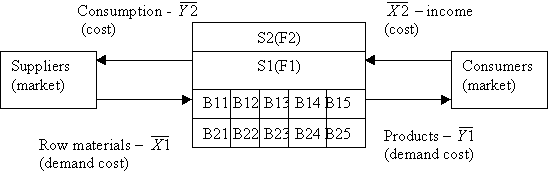
Fig. 3
frames by a deckhouse of the rationes of the cost not only in relation to reverse supplies available (raw materials - yields), but also in relation to a fixed capital (means, schemes, staff, proficiency, norm (fig. 4).
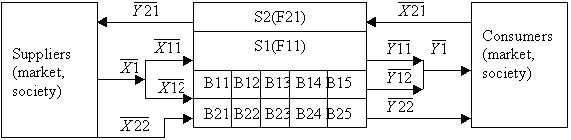
Fig. 4
On long time phase the function of a technological system F1 narrows down the significance and becomes a function F11, two functions F12 and F22 are added, and the function of an economical system F2 is extended and is renamed as F21, in linkage with origin F22.
(c5) We shall consider frames of costs, profit and profitability of manufacture. On short time phase (the fig. 3)it is: the cost of raw materials  in the molding box of the consumption and transferable function F1, but taken into account by a function F2, cost of a fixed capital В11, В12, В13, В14, В15, В21, В22, В23, В24, В25, which one in the sum determine the cost price of yields
  (
( c). The profit (
 ) is determined as a difference between the income and cost price
  c, i.e.
|
|
(12) |
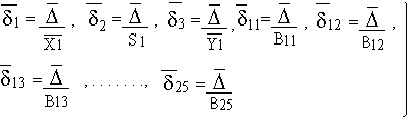
The profitability of manufacture ( ) can be defined as the ratio of the profit () to any of the factors of manufacture (
 ,
,  , , В11, В12, В13, В14, В15, В21, В22, В23, В24, В25):
|
|
(13) |
On long time phase the frame of costs, profit and profitability varies. The vectors and  , enveloping new fixed capital new staff and his tutoring new technological and economical norms are added. Their cost follow-up is actuated in vector
  . The output vectors
  ,
,  , enveloping substituted fixed capital dismissed staff, obsolete norms are added also. Their cost can be profitable, but, in base, account (waste utilization, deduction in a pension fund etc.) and with conforming is familiar are allowed in vector of the incomes
  . Accordingly, the profits and profitability vary makeup and frame of production costs. Such makeup and frame are characteristic not only for any manufacture on long-time phase, but also for many modern manufactures on short time phase (at orientation to new technologies, on policy of sales etc.).
(c6) The production Functions, as Kobba-Douglas and Leontev, will match to operation of a manufacturing system on short time phase (fig. 3), but they only partially mirror the ratios of a manufacturing system. Production function includes the capital, which one will be used by the firm, but only its wear is actuated in production costs. At the same time, the expenditures of a transactions are actuated in production function by the way of stream, instead of stock. Therefore Q from (1) and (2) will match consumption cost with the cost mirrored part of vector  . The expenditures of a transactions L will match of the again created cost by staff В13 and В23 with proficiency В14 and В24. The capital envelops raw materials
  , means of productions В11 and В21, technological (В12) and economical (В22) of the scheme, technological (В15) and economical (В25) of the norm. As a whole, the frames of a manufacturing system (fig. 3, 4) allow more precisely to estimate entirety and conditions of usage of production function.
Object of study of modern microeconomics is, as is known, economical activity of the people and blanket economical problems, originating in its courses solved according to existing institutes (the market, property and state) and public frames.
The manufacturing systems envelop only part of the economical ratios of microeconomics. Accordingly, the essential of microeconomics studies that in relation to a manufacturing system will form its environment (supply and demand, market balance, consumption, welfare and economic policy, branch, market of the factors of manufacture, labour market, capital market, market authority, state competitive policy, public goods and other).
(d1) From stands of systems analysis, environment of the metallurgical operation as manufacturing system is all that does not enter into manufacturing system. In showed sample pieces of a manufacturing system (fig. 3,4) it is disintegrated on two: technological and economical. There are two bases too two with identical frame: means and schemes of manufacture, staff and proficiency, norm. All remaining is environment. But the environment is endless. How can it be limited?
The environment limits by those in objects, which one render the greatest influence on a given system. First of all, we shall mark objects, which one are the constituent of the firm, but they external in relation to a manufacturing system. It is a financial system and management system.
The financial system has national scales and envelops: financial organs, banks and other state organizations, securities market, banking credits. The financial system mirrors the economical ratios in society, one of its elements is the finance of the enterprise, on which one it is possible to judge a degree of reaching by the firm of its main purpose (profit for a private firm, sufficing of public needs for the state operation).
The management system of the operation is uniform, therefore manufacturing system is one of its objects of running (along with supply, sales, marketing, external economic and other services). The management system will run by a manufacturing system on a given main purpose, using a feedback channel (for map of manufacture as object of running) and control channel (for action on manufacture).
(d2) Feed forwards manufacture has with the market. On short phase these linkages limit saled products and bought raw materials. The market is uniform, however on an input manufacture has the ratios with a system of a supply, and on a exit with a system of demand. Accordingly, the system of demand is studied by the theory of demand and is characterized by a function of demand, and the system of a supply is studied by the theory of a sentence and is characterized by a function of a supply.
The function of demand, as is known, calls association of magnitude of demand (QD) from controlling factors acting selection of the buyer:
|
|
(14) |
where P - price of given production; (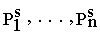 ) - price of the goods substituting given product in consumption; (
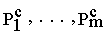 ) - price of the goods complementary the given value in consumption, or complementary values; Y - income of the customer selected by him for purchasing of the given goods; Z - tastes and preference of a customer; N - objective, natural conditions of consumption; Е - expectation of customers.
The function of a supply, as is known, calls association of a volume of a supply (QS) from the factors influential in seller's option:
|
|
(15) |
where Р,  ,
,  - see (14); С - production costs; Т - taxes and grants; N - objective, natural conditions of manufacture; E - expectation of the producers.
The associations (14) and (15) are characterized by large complexity and demand for scaling the vast statistical data, therefore in practice them limit to more simple expressions:
|
QD = f(P) |
(16), |
|
QS = f(P) |
(17). |
(d3) On long time phase in an environment of a manufacturing system the objects are follow-up mapped, on which one the vectors close on ,  , ,
, ,  , , (fig. 4). These objects actuate a labour market, capital market, ecological medium, interlayer of the retirees etc.
The labour market is a region of the market ratios, where are formed a supply and demand on a transactions, the division of labour and definition of the prices on different aspects of labor activity is ensured. The transactions is the goods, which one is nonseparable from his proprietor - person. Thus in free society person is not the subject of sale and purchase. A transactions and its proprietors take different meshes in a modern sample piece of a manufacturing system (see fig. 3): the transactions envelops meshes В14 and В24, and its carrier includes mesh В13 and В23.
The capital market is characterized not by a stock, but streams of the new capital, which one occurs in the given phase in manufacture. The demand for services of capital manufacturing resource in the firm is determined by a difference between streams of services available on the firm in the given moment capital the values and desirable stream of services of the capital values. The desirable modification of a stock of the capital determines the investments. The investments are mapped usually not by the concrete capital values (machine tools, equipment etc.), but temporarily by free money resources. Therefore capital market is the market of the money capital.
In a system sample piece of the metallurgical operation as manufacturing system (fig. 3) the invested capital enters by a part of vector , and values, gained on it (means of productions, technologies and norms) - vectors , and meshes В11, В21, B12, В22, В15, В25).
The ecological medium is acted with waste product from  , (fig. 3). The ecological medium is usually characterized by marginal impurity of chemical agents, its polluting, and their flowing values. More composite sample piece of an ecological medium envelops other characteristics of the nonliving and alive nature (geologic frame, availability of alive organisms, animal and flora etc.).
The society is acted with output vectors of a manufacturing system from , (fig. 3). It, first of all, workers retiring, obtained occupational diseases, employment injury etc.
 =
=  –
–  c
c