KLYAGIN, Gennady & VOSKOBOINIKOVA, Nina
58, Artema, 340000 Donetsk, Ukraine, Donetsk state technical university, dfst@pop.dgtu.donetsk.ua;, www.dgtu.donetsk.ua
Adstract: At present training of engineers is more and more often considered in the context of many world processes globalization, business, trade and some specialists practical activity being subject to them.
The developed societies more and more feel the necessity in wider knowledge with the help of which it could be possible to solve the most difficult society problems. This knowledge is becoming more accurate and refined. Knowledge on different disciplines promotes any professional training. Foreign languages can and should compose a unit of wide professional culture.
Training of business and professional foreign languages occupies a particular place in the course of general linguistic training in the engineering educational institutions.
4 years ago Donetsk State Technical University (DonSTU) developed and implemented the conception of training engineers with specifically deep studying of foreign languages.
Keywords: education, globalization, plurilinguism, linguistic training
The modern world globalization tendency presents a gap with the traditional international economics model. This model main hypothesis based on the manufacturing factor immobility: only products were able to circulate outside the national borders. Under this situation the products (trade), manufacturing factors (industrial delocalization) and capital (international financial markets) movement speeding up takes place.
These economic game new rules obviously introduce a new style and relations in the business world. On the one hand the necessity to act and react under the conditions of the time shortage orients on the monolinguism in favour of the English language which dominates since the end of the World War II. On the other one we come across the reverse phenomenon stipulated for the necessity to consolidate continuous economic exchanges.
Interstate engineering practice is more often conducted not only by transnational corporations but small businesses and experts who act independently. Practical activity philosophical and social aspects, communication skills including foreign languages are paid great attention to in the course of engineering training. As to the nearest future there is a task to train young engineers who are able to speak one foreign language fluently and understand two or three of them. The sensation growth of the demand on technical and linguistic education, which is already felt at the universities and colleges, can be expected.
It is necessary for the Universities to be ready to meet the social order connected with the linguistic training in the sphere of a business foreign language.
The developed societies more and more feel the necessity in wider knowledge with the help of which it could be possible to solve the most difficult society problems. This knowledge is becoming more accurate and refined. Knowledge on different disciplines promotes any professional training. Foreign languages can and should compose a unit of wide professional culture.
Training of business and professional foreign languages occupies a particular place in the course of general linguistic training in the engineering educational institutions.
Some serious quality changes in the system of training specialists in Ukrainian engineering educational institutions are taking place now. The orientation on integration into the European system of higher education caused the introduction of the three-level system: Bachelor, Specialist, and Engineer. In accordance with the professional orientation there is the basic higher education with 4 years training. It is possible to continue studying to obtain full university education within 1-2 years. The choice between engineering and research training is made only at the second level. 90% of graduates get the engineer diploma.
Recently the aim of the foreign languages courses at technical universities has been to teach students to read professionally oriented texts which presented only one rather limited reception type of speech activity. The amount of teaching hours didn’t allow to teach practical foreign language purposefully. Establishment of various contacts with foreign countries, the students desire to master oral speech and communicate in a foreign language with the application of their knowledge put forward this task.
4 years ago Donetsk State Technical University (DonSTU) developed and implemented the conception of training engineers with specifically deep studying of foreign languages.
The conception stipulates for the considerable increase of teaching hours connected with foreign languages studying, establishment of special engineering faculties (French, English, German), introducing of a number of new disciplines (technical translation, business and professional foreign languages), identification of the students business competence acknowledged by special certificates which show the level of general technical language and terminology knowledge. Special sub-languages knowledge is certified at special Certificate Centres. It is done on the base of the international cooperation agreements. The University arranges special linguistic practice which is carried out in conditions of absence of real foreign language communication. Some research and methodology projects are being carried out here. Thus, for example, the French Engineering Faculty (FEF) is implementing the research project called The Conception and New Technologies of Specific Foreign Language Training with Taking into Account the University Engineering Orientation. The project development is stipulated for the order obtained by the University on training specialists who know foreign languages. The French certification system is taken into account: the students get the diplomas DELF/DALF on French as the second language.
The obligatory basic level of linguistic knowledge was stated for the students of « the Russian language» faculties which is stipulated for the qualification characteristics demands (the first stage of training). Students who passed the foreign language exam have a chance to continue the language studying at the second and third levels.
Engineering educational institutions students have specific language demands. But these demands depend on the language practice which is inseparable from the sphere of science and professional communication , and doesn’t depend on the students specialty. That is why the elements of the technical language are introduced at the level of the general linguistic training. Further on when the teachers who train foreign languages and those who train special technical disciplines work together this base is deepened and widened due to the introduction of new courses trained in a foreign language and arrangement of classes: technical translation, course works and projects, lectures, research records, diploma projects. Parallel to their basic specialty students have a chance to make technical texts translation and process science and engineering information written in a foreign language.
At present we are working at the methods of distance learning with the help of the INTERNET.
To continue studying at foreign universities our student should be able not only to communicate orally or in a written form , but practice work which is never done in their mother tongue. We mean new experience or simple skills transition. For our students studying abroad it would be useful to know how to make notes in a foreign language, how to inform somebody on something and write their curriculum vitae. They should know the reading strategy and how to word the motivated letter and write references etc.
To teach this is not the direct aim of training. But these elements introducing into the foreign language training process is subjected to the strategy which combines the language and non-language skills training.
To evaluate the students technical and science foreign language communication competence we use the situations similar to those in professional environment. It shows the students ability to do the task connected with the given sphere professionally.
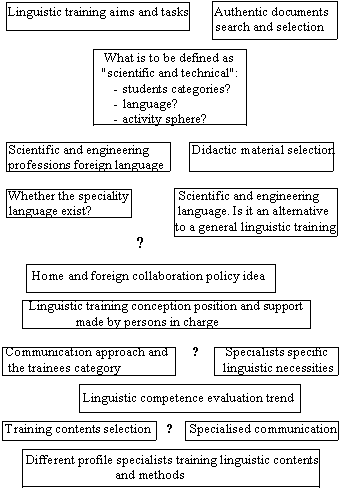
In front of the life necessity to understand any information in foreign languages and to be understood and informed in the professional environment the linguists, specialists and researches , and teachers initiatives are directed to new methods search permitting to gain European foreign language knowledge as soon as possible. This rather a serious task includes different problems which foreign language teachers meet. In general these problems are as follows:
Debutantes (the students who start to study the language with very beginning) and false debutantes (the students having the secondary school language knowledge level) are trained French at FEF. Communicative approach is the base of training/ learning. Under this approach a foreign language is trained on the communication base, the situations, oral speech and strategies being important: a trainee has to learn to communicate in a foreign language and therefore to seize the communicative competence. Communicative competence different definitions could be presented as follows:
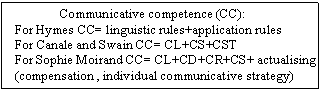
CC: communicative competence, CL: linguistic competence, CS: social and linguistic competence, CST: strategy competence, CD: discursive competence.
The definition given to communicative competence given by Sophie Moirand is the most complete.[2] It is taken into account when a course programme is developed. The communicative approach success depends on the teacher. There are three observances requirements on the teacher level:
The second requirement covers the links with the acting local system. With the communicative approach we are not speaking about systematised practice introduction and refusal to bring in some types of exercises because of their belonging to a different methodological trend. We are speaking about introducing of the approach directed by some basic principles taking into account the pedagogic situation practicability. Our foreign language training situation is reflected in such a way:
At different stages the foreign language training has a double goal: formative and communicative. The degree of attention paid to the formative or communicative aspects depends on the training situation and immediate goals.
The University general linguistic training is oriented on the communicative aspect. But it pursues the formative aim as well as it enriches students intellect. It is with the help of foreign language studying that students have access to a different culture and new knowledge.
The students necessities are not strictly defined by the moment of the language studying. But when the students are aware of when, where , how and why they will have to speak a foreign language the specific language training is introduced. At DonSTU the latter is an addition to the general linguistic training.
The programme of the course oriented on communication and divided into smaller units in accordance with the goals and amount of the French language training hours can be developed on the basis of last French methods (French as a second language). This was done at FEF correspondingly to our training/studying situations.
Our courses are stipulated by the necessity in quick and simultaneous development of all abilities in French as a second language: oral and written understanding, oral and written reproduction. Our first year students are able to go ahead in the language mastering very quickly.
We don't lessen the role of each ability in French as a second language . But in our general linguistic course special attention is paid to the development of oral and written understanding abilities.[3] The understanding ability factor provides for the one third part of progress in foreign languages mastering . It is this well developed ability that allows students to get an access to different types information (including scientific and engineering) understanding (both in an oral and written form). More than that, it gives a chance to be trained in French at different foreign universities.
Oral and written information understanding depends on many factors:
The oral understanding activity goal is to give students a chance to understand a natural speech which differs greatly from a written one. The level and contents of a real communication depend on it greatly.
The real speech characteristics and its understanding difficulties are as follows:
To develop skills and strategies which students need to master a natural speech it is necessary not only to foresee authentic or interesting realistic documents, but corresponding types of activity the aim of which is corresponding competence type mobilising, improvement and application as well.
We'd like to emphasise three very important reasons of application of authentic documents being a privileged material:
The analysis technique to single out the taught /studied communication functioning rules is applied as to the authentic documents.
The oral understanding ability development is based on activity certain types which can be divided into three categories:
The activity can be directed to the special language application while the information is listened to or after that:
The class is organised due to the activity steps.
You should not come to a conclusion that every step is to contain audio information processing activity. Pedagogic activity is influenced by the students interest and necessities, the taped text characteristics and the activity goals.
The importance of every oral understanding development activity stage can't be spoken about as each of stages has the absolutely exact goal. But the activity types when the information is listened to are of great importance. Every teacher asks himself/herself one of three questions "What?", "When?", "How?" when he/she thinks about own training methods. It is the information listening stage when those questions arise.
The students ability to simultaneously evaluate the text and working at it, to define and solve the oral understanding problems is of great importance.
A French song, always charming and having inexplicable magic force, is introduced into a general French language course being a component of the communicative module directed to oral understanding development. Studying the French language by means of a French song provokes students interest and gives a birth to many creative activities. It is the motivation inexhaustible source.
Written understanding training is aimed to teach students to read and adequately understand authentic texts and to single out necessary information. The general linguistic course contains different authentic documents the work at which is directed to develop and reach a certain competence:
This proposed to students different texts typology having corresponding reading strategies promotes the foreign language texts reading tastes and pleasure. The written text being an information source is an important means to introduce new context lexis.
Pedagogic activities on oral and written understanding development is undertaken due to the scheme:
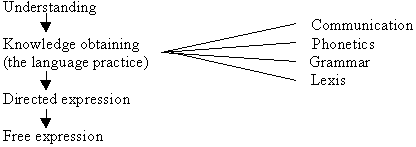
Communicative competence development is the intensive language practice goal. This practice is organised in real training/studying conditions. This practice type programme puts an accent on the oral understanding ability.
FEF organised training in order to meet the only simple and understandable aim: to help students to be able to work in French as soon as possible and in the most efficient way.
The University engineering orientation language training contents depends on the importance attached to the following goals:

The necessity to work on the following aspects is conditioned by the specific aim of language training in an engineering school:
The list of directions reflected in the specific training contents helping students to work in a foreign language is far from complete.
The elements of scientific and engineering language are already introduced on the general linguistic training stage. Further on when the teachers linguists and special disciplines instructors work together this base is deepened and broadened due to new courses introduction, foreign language classes organisation: technical translation, course works and projects preparation, lectures attendance, scientific essays writing, diploma papers preparation and defence. There is a possibility for students to get their main speciality training and to have skills in technical translation and scientific and technical information processing at one and the same time. At present the distance learning methods through the INTERNET channels is under discussion.
To continue their studying in France or in any other country where the French language is native the students have not only to have good command in conversational and written French, but to practice work which is not so familiar for them as their native language bearers. It is a question of new work methods, new experience obtaining or skills simple transferring. These are work aspects corresponding to the skills mastering of which could be useful for those planning to study abroad: making summaries in French, methods of reports making , reading strategy, curriculum vitae and motivated letter editing, bibliographic references.
To practice above mentioned is not the training direct goal, but their introduction into the course of French as a second language is subjected to the strategy which combines the language training with non-linguistic skills training.
To evaluate the students communicative competence in scientific and engineering French the situations similar to the professional environment and testing the students ability to fulfil their task on a professional level are practised. Both oral an written skills are evaluated.
The abilities of oral and written understanding , making statements in a written form are checked when written skills are tested. The tasks contents can be as follows:
Oral understanding: to participate in the conversation on general scientific and engineering problems; to distinguish the language register, consent or disagreement, doubt or other nuances; to fulfil the task in accordance with the explanations or detailed instructions on a particular problem (on the telephone or in a working situation); to participate at a meeting, to understand the colocutors point of view, to present the scientific or engineering information to the radio or television programmes.
Written understanding: to use the professionally oriented text (instructions, a brief report, the way of application, procedure); to read special authentic document fragment or the whole document and to extract necessary information; to use the written text exact elements (a letter or a report) with a certain aim; to check the working document and to make sure it doesn't have mistakes and nothing is omitted.
Written utterance: to compose a draft of the reply on a professional business correspondence (e.g. a letter draft); to fill in a current working record of service, to make up a simple report (acknowledgement or cancellation), to compose a typical letter in accordance with an offered pattern; to form a brief report on the specialists visit, on the work done , on the event or situation connected with the professional activity.
Oral utterance: to pass oral (on the telephone on under the working situation) current professional information (a business meeting, report, referendum data); to read the proposed text in a loud voice and distinctly; to give instructions on the task fulfilment; to ask for additional information; to ask for professional information; to form objections and give grounds to them; to answer simple questions being interviewed, to briefly express the personal opinion on a professional problem, to give arguments in its favour and in the favour of the problem's positive solving.
Application of new methodics based on original French text-books allows the students having no knowledge in the language not only to attend lectures on fundamental and general engineering disciplines delivered in French on their second year of study, but make summaries.
The results and experience obtained prove we chose correct directions as to linguistic training. Our first 33 students have passed the science and technical French international exams and got the certificates issued by Paris Chamber of Commerce.